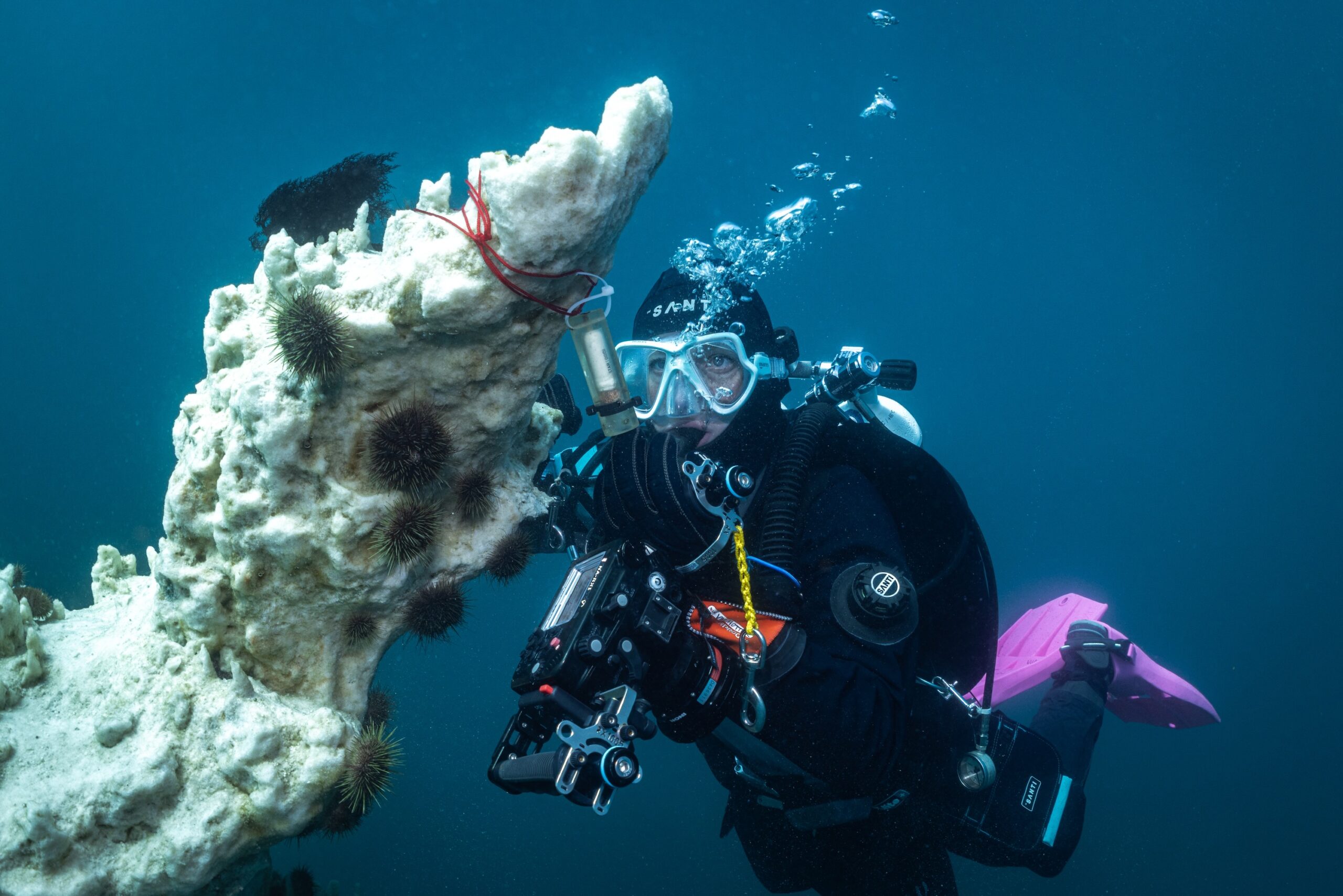
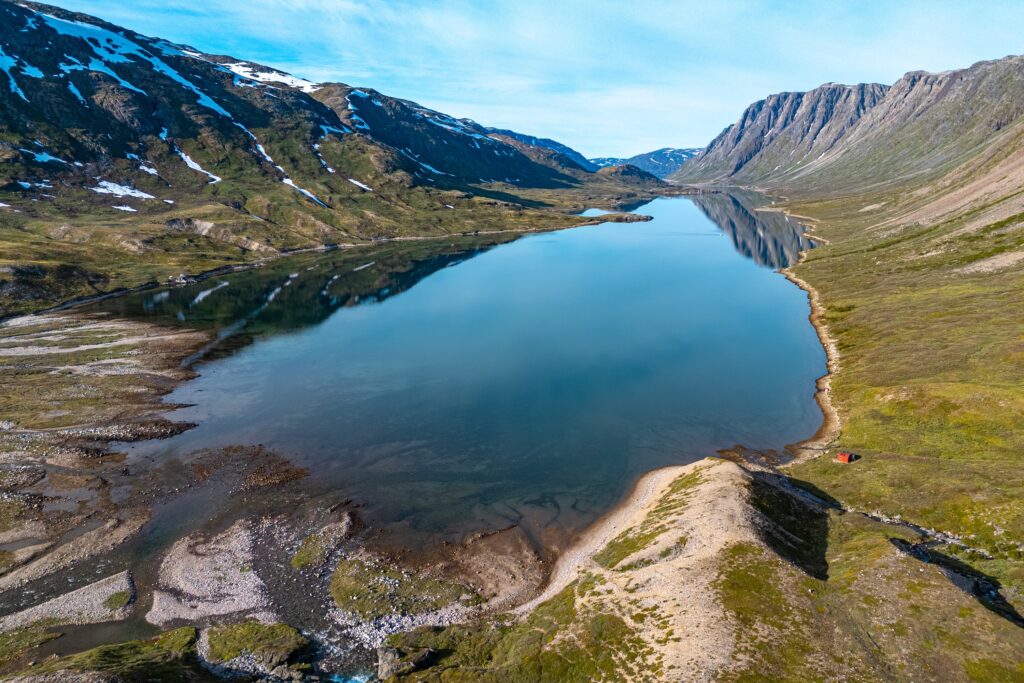
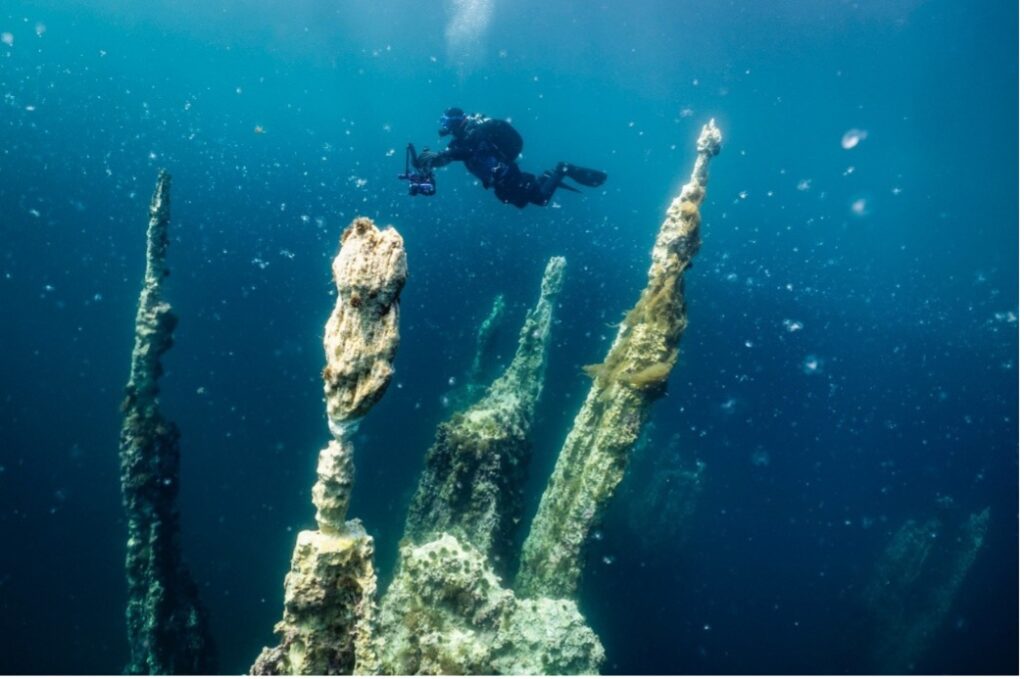
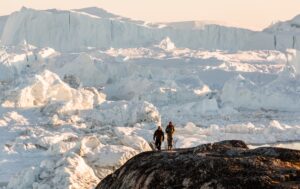
The existence of mesmerizing columns under the surface of Ikka Fjord has long been known, but only in 1963 did scientists find out that they were made of an unknown mineral, soon to be named after the location. Ikaite forms only under very special conditions, and it transforms into different minerals in temperatures above 6 °C (43 °F). This fjord in South Greenland has for centuries provided just the perfect environment. Here, ikaite has grown into nearly 1000 stunning pillars, up to 20 meters tall and teeming with life. Naalakkersuisut (Greenland Home Rule) declared the area a protected site in 2000.[1]
As the climate changes and temperatures rise, variations in the marine environment risk altering the mineral composition of the columns, causing them to collapse and become inhospitable to the rich ecosystem that is currently thriving on them.
Fieldwork and dissemination
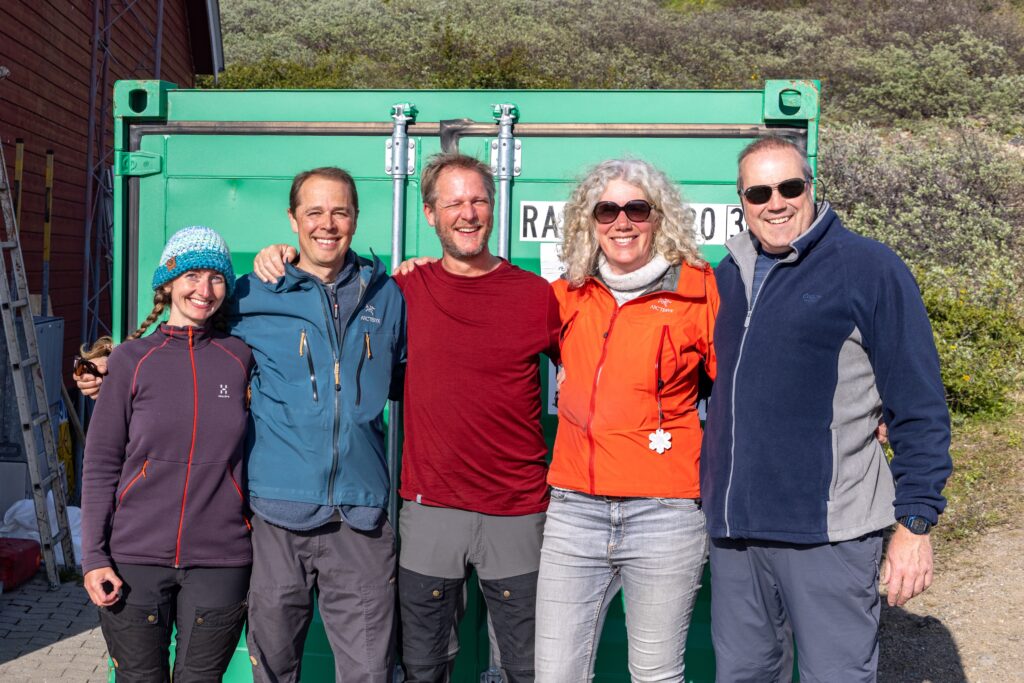
Geologist Gabrielle Stockmann has been studying the ikaite formations in South Greenland since 1995, when the interdisciplinary IKKA project examined the ikaite columns and mapped their occurrences at the fjord floor for the first time. She now leads a research team based at companies and universities in Sweden, Denmark, UK, Germany, and Greenland: they carry forward decades of work to better understand how ikaite is reacting to a changing Arctic and how it can be protected.
The Nordic Arctic Co-operation Programme funded fieldwork in Ikka Fjord (2022, 2024, partly in 2025), as well as subsequent analyses and extensive dissemination activity. Professional divers were hired to take samples from the columns and document the site through photographs and videos. During the latest fieldwork, an additional grant from Aage V. Jensen fond allowed to instal dataloggers that will be recording data autonomously for the next few years.
Subsequent tests were conducted using specialised technologies available at the University of Gothenburg and the University of Iceland. Meanwhile, Aarhus University launched an online database that will collect all research and visual documentation from the past 30 years.[2]
In addition to academic conferences, publications, and popular science, in 2025 the project team outlined and shared a monitoring programme with Naalakkersuisut, the Government of Greenland, highlighting the risks that climate change and mining activity pose to Ikka Fjord.
Wider impact
In Greenland, entrepreneur Kunuk Albrechtsen has provided essential logistical assistance during fieldwork and facilitated connections to the local community in Arsuk. Information and visual materials have been shared with Arsuk’s school and can be used to develop sustainable tourism in the area in the future.
The research project has also uncovered ikaite’s potential for capturing and storing atmospheric carbon dioxide. Experimental facilities are currently testing the process in Denmark; if successful, Greenlandic companies could follow too. This efficient new method would contribute to compensating CO2 emissions while generating a commercially viable by-product, i.e. ultrapure calcium carbonate.
The ikaite columns project has drawn upon diverse expertise from the Nordic and Arctic region, aiming not only at preserving a unique natural phenomenon but also at channelling new knowledge into sustainable growth, locally and globally.
30 years of focus on cooperation in the Arctic
The Nordic Council of Ministers has focused on cooperation in the Arctic for 30 years.
A large part of the Nordic land and sea areas lie in the Arctic region. The Nordic region is therefore strongly engaged in issues relating to this unique and harsh, but also vulnerable area.
The Nordic Arctic Programme 2025-2027 aims to support socially, economically and environmentally resilient Arctic societies. By promoting resilient civil societies, sustainable economic growth and green transition, the programme will support local initiatives and partnerships that inspire resilience in the Nordic-Arctic region. With the Nordic Arctic Programme, the Nordic Council of Ministers will support innovative Arctic projects that are in line with the Nordic Council of Ministers’ Vision 2030.
This series of articles deals with various projects that have received support through the Nordic Council of Ministers’ Arctic Focus over time. The program has had different titles over the years, from 2022-2024 the program was called the Arctic Cooperation Program and from 2025-2027 it is called the Nordic Arctic Program.
Facts about the Nordic Arctic Program
To ensure that a project is rooted in both the Arctic and the Nordic regions, a collaborative project must always include partners from at least three Nordic countries. That is: Greenland, Iceland, Norway, Sweden, Denmark, Finland, the Faroe Islands or Åland.
This can be supplemented by one or more Arctic partners outside the Nordic region, as long as the lead partner is from one of the Nordic countries.
Read more about the Nordic Arctic Program here.
Further read on the project can be found at Arctic Hub and Sermitsiaq.