


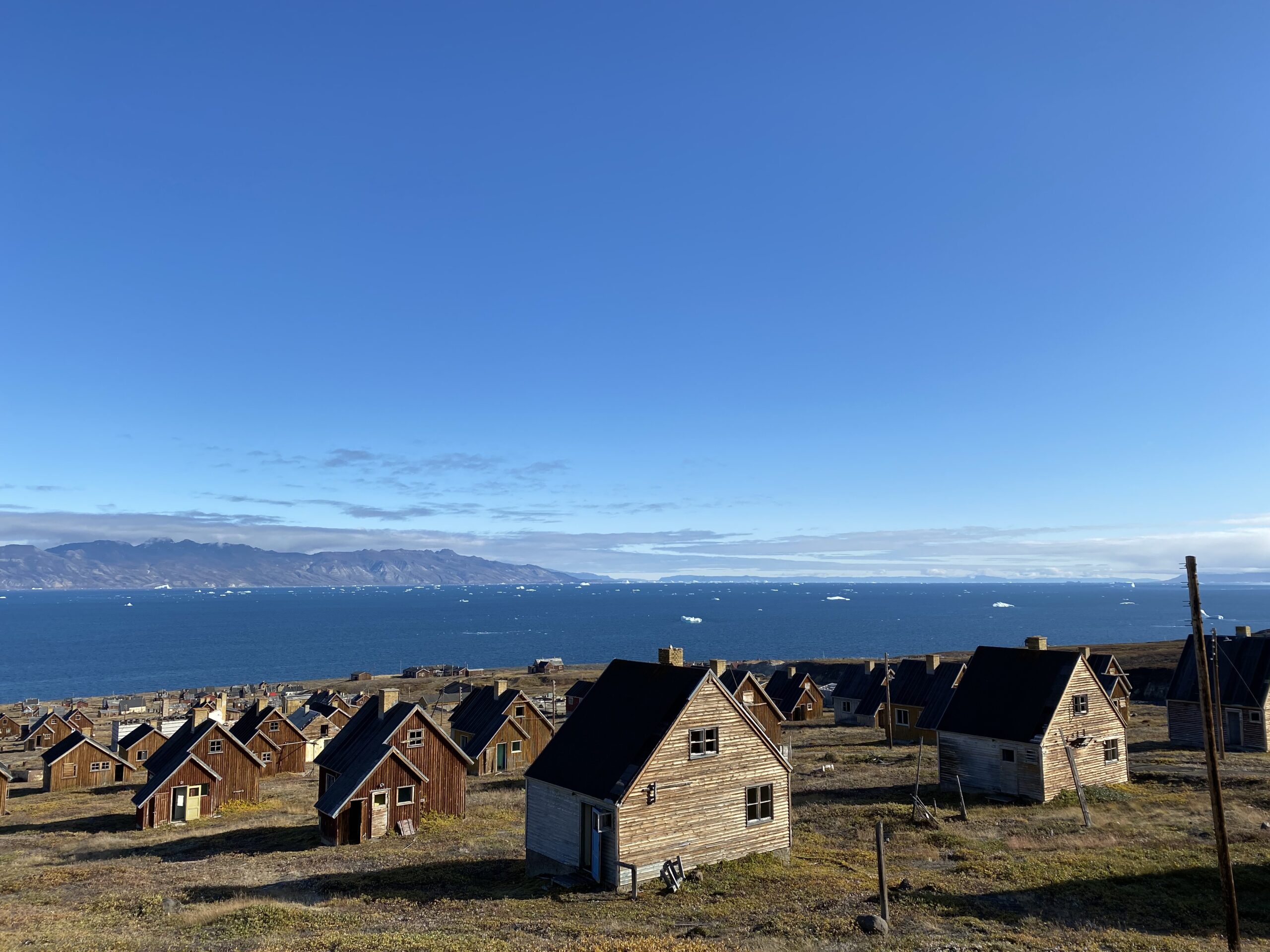
K´utdligssat – an abandoned city, seen from bird’s-eye view
We didn’t just visit 13 inhabited places, and told the locals of the many opportunities they had with NAPAs Culture Funding during our travels to North Greenland, we also had an opportunity to visit the mining city Qullissat, that was closed down in 1972, when its mine was discontinued.
You could already sense the type of life that must have existed in the city 50 years ago, from the dock of the ship ‘TULU’.
When the “ship’s doctor” Michael Krogsgaard (who wasn’t actually the ship’s doctor, but a doctor, and a fellow passenger), and our intern, Maasi, got set off on the beach, they found a foundation just above the beach. The house that had been there, had fallen apart long ago, and the remains of the ruins had probably been swept away from the wind, down to the shore, where the waves had carried them away, forever saved, and forgotten.
This is where we start up the drone to fly.
While the rest of our travel companions spread out towards every direction, Michael and Maasi follow the nearest path, which goes up through the lower parts of the city. Between the many houses of various shapes and colors, they capture the moments in photos and film, and Maasi gets to further practice controlling the little winged machine. As Michael has told many times before, since the drone first took flight in Sornoro, it is keeping itself quite well and stable in the wind.
The drone quickly runs out of battery, mainly because they are filming a lot, so Michael gets a new battery in it as they reach the old hospital. The drone once again takes flight, but we make sure to keep the filming to a minimum from now on.
The city scene changes further up, as the houses take on natural colors, from the previous colorful varieties, and become more similar to each other, with very little differences.
The Castle
We head towards the river, and on the other side, you can see The Castle. A massive house with three floors that still stands tall over the sea, despite the wind and weather.
Unfortunately, the drone doesn’t get to fly over The Castle, as we didn’t take Michael (who had packed the drone along the way) with us over the river. Though there weren’t that much water flowing through the river, the stones were, on some places, covered in clay, and Michael, who is good and well up in his years, didn’t feel it safe to cross.
The Castle is quite a sight, and if you should visit Qullissat, then you just have to visit the house with the many, large rooms.
From The Castle, our path takes us to the graveyard, where we meet many of our travel companions, and together we move towards the beach as our time here comes to and end.
We’ve spent three ours in “The city that will not die”, a permanent reminder of a greenlandic politic that, to this day, five decades later, is still being discussed between all people great and small.
Other news

Nordic strings in Greenland
The Nordic string group Unison Strings has made workshops for children and young people and played concerts in Greenland Since 2014, the inter-Nordic classical string festival, Unison Strings Festival – Greenland, has been inviting string students and professional string players from Greenland, the Faroe Islands,

Susanne Andreasen becomes new director of Nordic Institute in Greenland
Susanne Andreasen becomes the new director of the Nordic Institute in Greenland, NAPA. Andreasen has extensive experience in the culture sector and theatre scene in Greenland. Among her other roles, Andreasen was the theatre director at the National Theatre of Greenland (Nunatta Isiginnaartitsisarfia) from 2016

Webinar about the Nordic Arctic Programme – and how to apply
Are you working with projects that strengthen civil society and sustainable development in the Arctic and Nordic region, or would you like to in the future? Then this webinar is for you. Join NAPA for an online introduction to the Nordic Arctic Programme (NAP) – a funding programme from the Nordic Council of Ministers supporting projects that: Directly contribute to the development of attractive and socially viable local communities in the Arctic across generations Support the development of local business opportunities and sustainable economic growth in the Arctic Directly contribute to promote green transitions and sustainable circular economy of

Nordic collaboration in Sisimiut: NAPA supports the Arctic Sounds Festival!
Arctic Sounds is an annual music festival in Sisimiut showcasing artists from Greenland, the Nordic countries, the Arctic and other parts of the world. The festival week is filled with music, events, workshops and other activities – including NAPA’s own event – in Sisimiut and its breathtaking