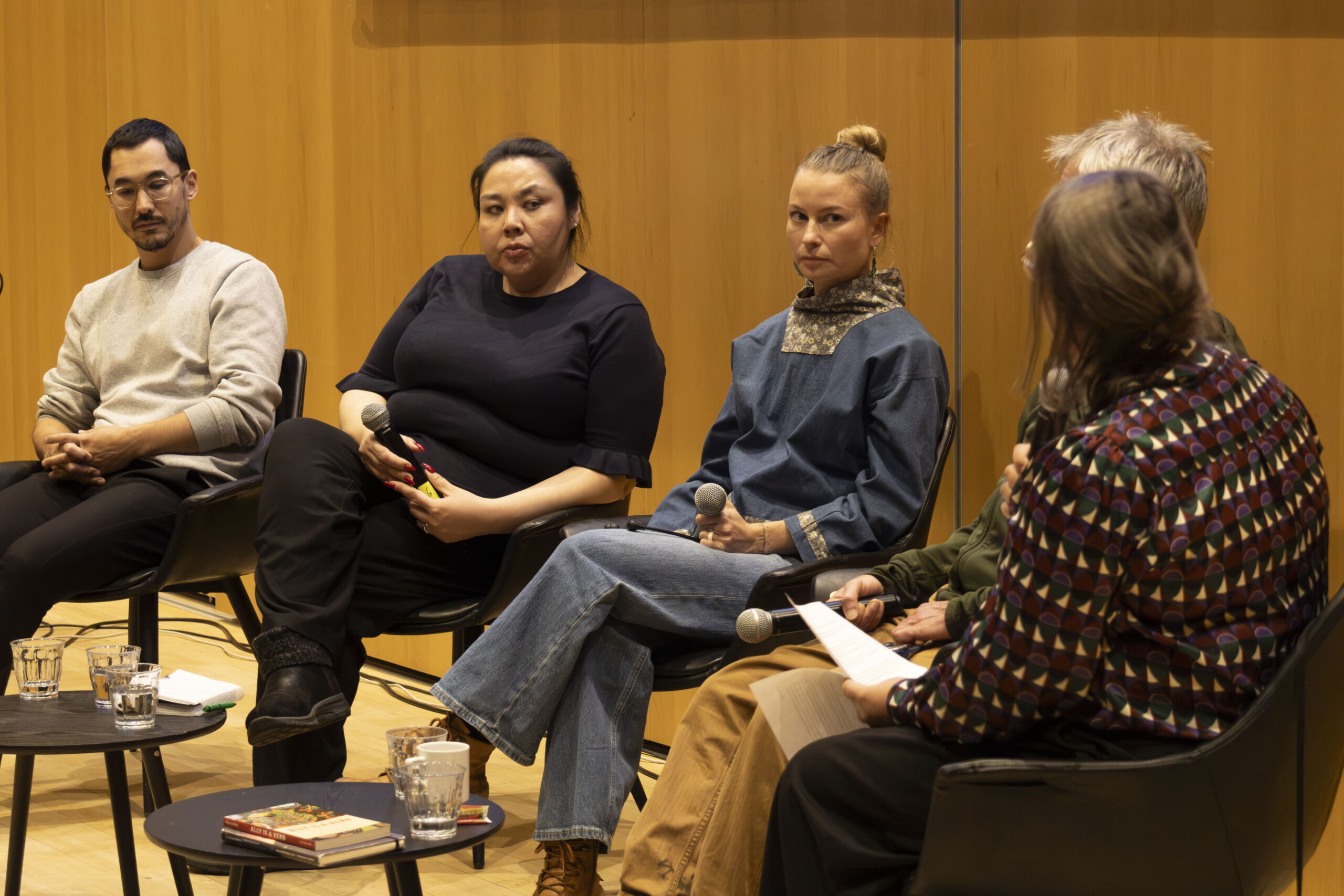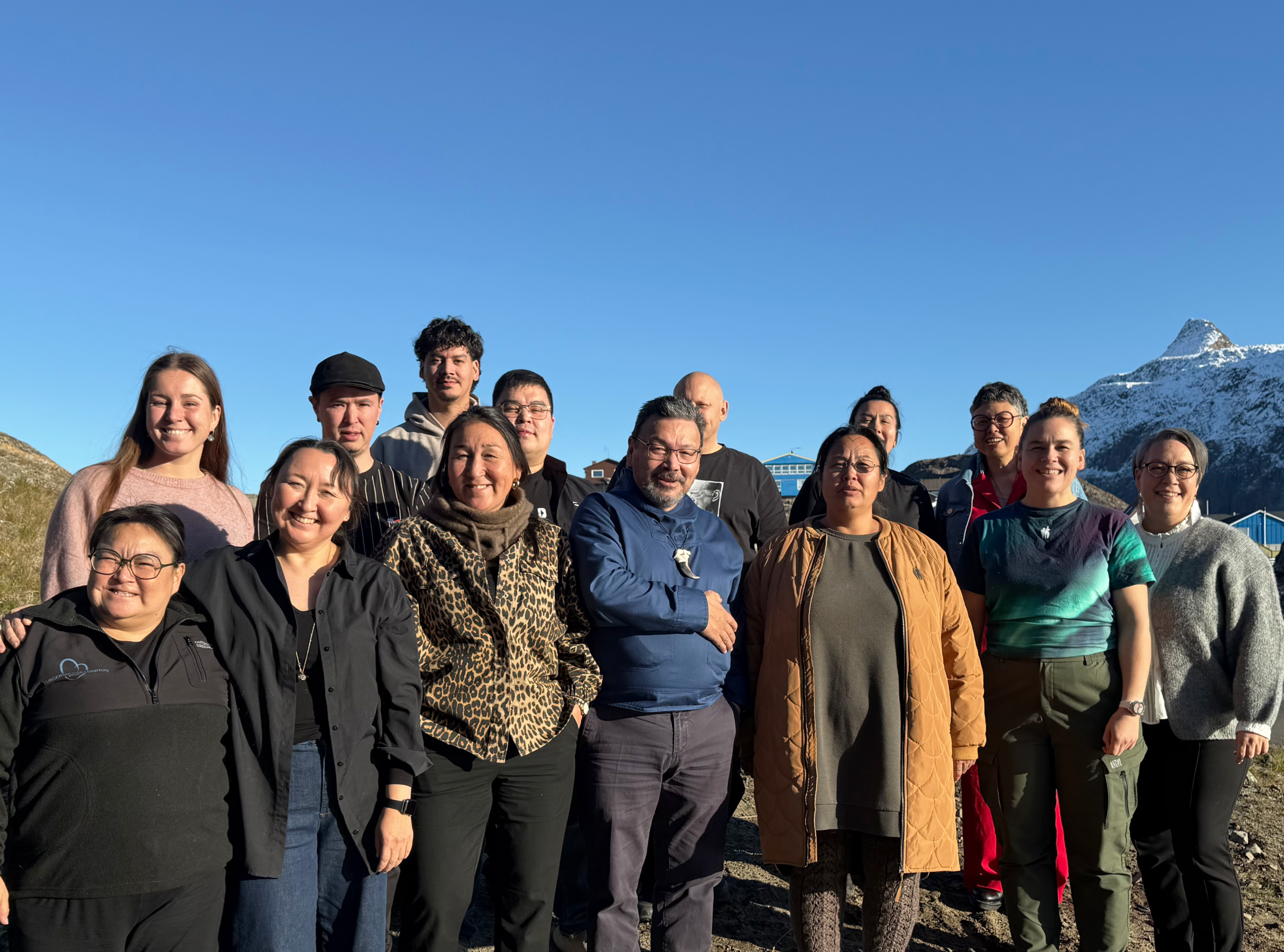
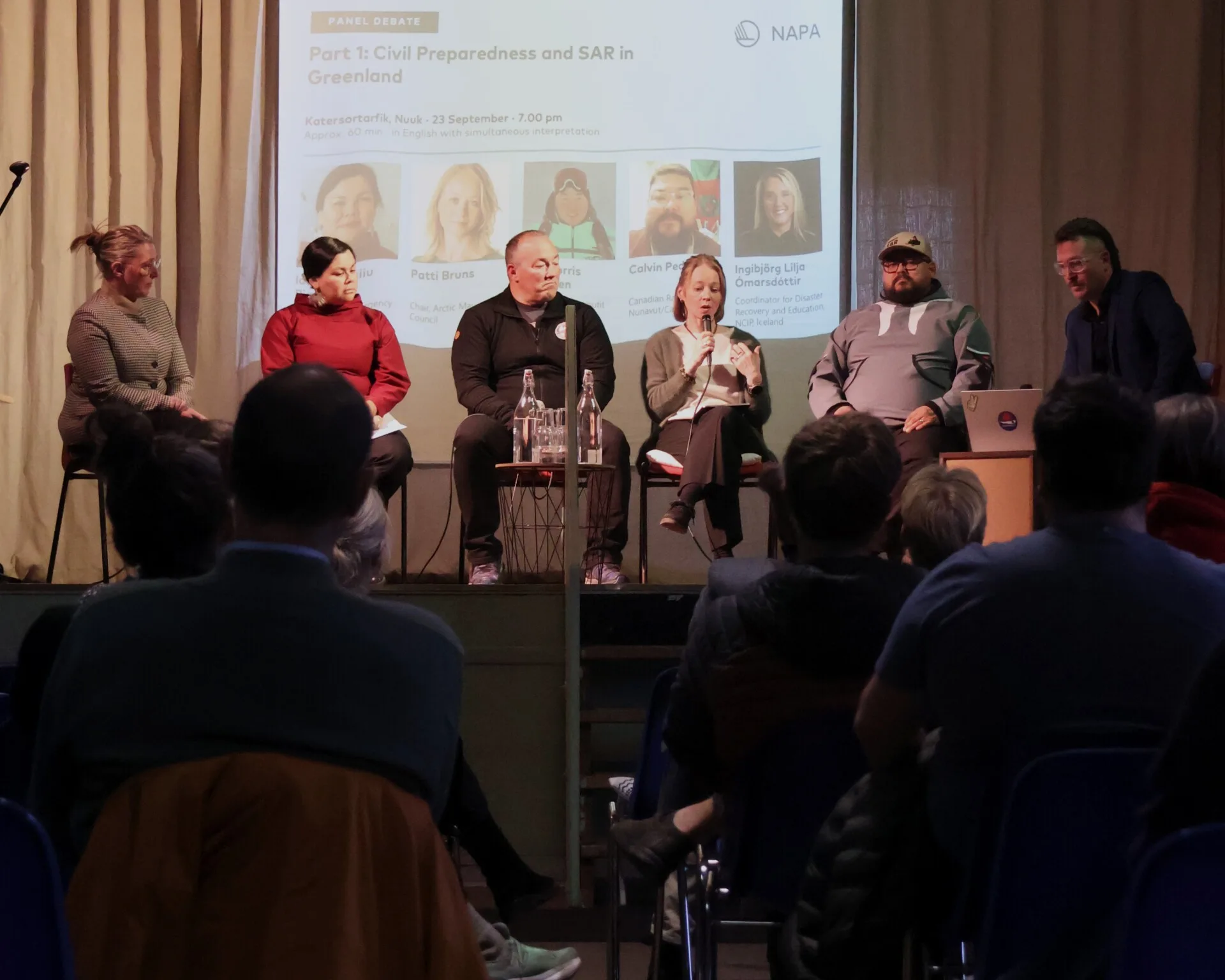
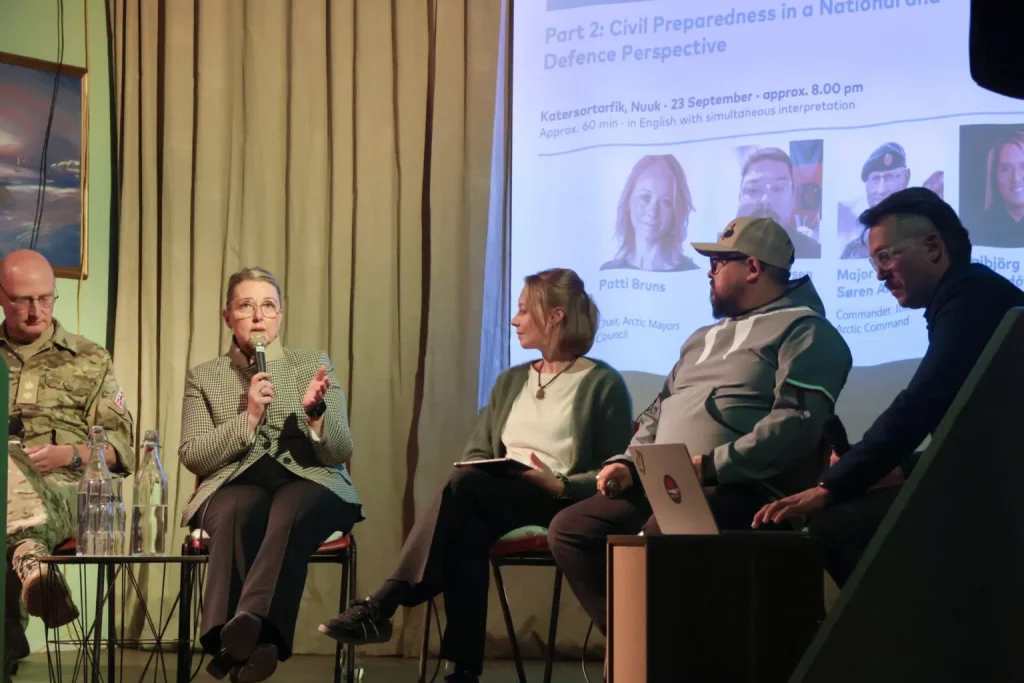
Representatives from the Arctic region met in Nuuk for two panel debates on civil emergency preparedness, search and rescue (SAR), and the importance of Arctic cooperation and coordination. The event marked West Nordic Day and the 30th anniversary of the Nordic Arctic Programme.
Panel participants:
Lars Borris Pedersen – Team leader, Qamutit SAR
Iddimanngiiu Bianco – Minister for Infrastructure and Emergency Management, Greenland
Major General Søren Andersen – Commander, Arctic Command
Calvin Pedersen – Head of the SAR service in Nunavut at Nunavut Emergency Management Canada
Ingibjörg Lilja Ómarsdóttir – Disaster recovery and training coordinator, Department of Civil Protection and Emergency Management (NCIP), Iceland
Patti Bruns – Secretary General, Arctic Mayors’ Forum
The evening opened with Susanne Andreasen, Director of NAPA, and the debates were moderated by Patrick Muller Abrahamsen, hoist operator at Air Greenland and emergency preparedness consultant.
The overarching questions focused on what civil emergency preparedness means in the communities they represent, and how well equipped Arctic societies are for the challenges of the future.
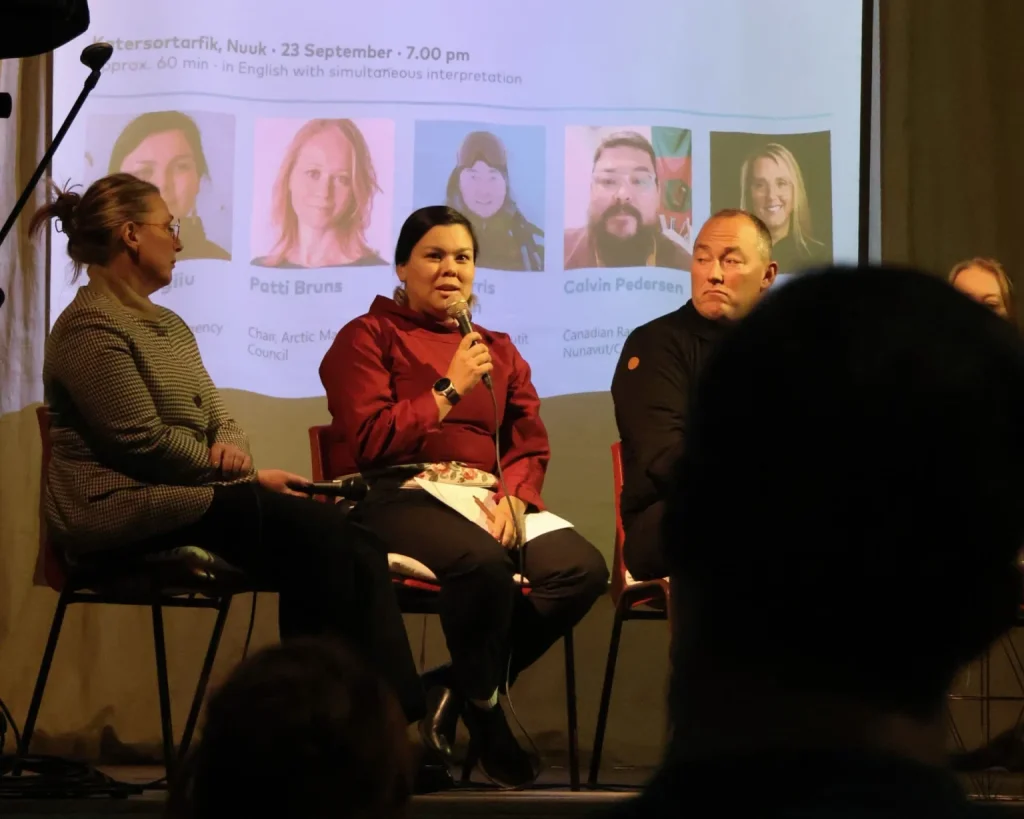
Local knowledge is crucial
Calvin Pedersen, a fourth-generation ranger with SAR Nunavut, shared experiences from the Canadian Arctic. He emphasised how search and rescue work goes hand in hand with strong local communities in less populated areas.
“As a volunteer, you often know the people who call in to report someone missing, or you know the person who is missing,” he said, among other things.
He explained that it is rarely difficult to recruit volunteers for SAR work, because helping one another comes naturally in local communities. At the same time, volunteers have extensive local knowledge of the terrain and conditions in the area, which is crucial in rescue operations.
This point was also supported by Lars Borris Pedersen from Qamutit SAR. He highlighted that trust in local expertise is absolutely central:
“There should be greater trust in local knowledge, as it is often local emergency response actors who know how to operate in the country as quickly and effectively as possible.”
Need for stronger cooperation across the Arctic
Increased cooperation and stronger coordination efforts were recurring themes in the debate. This is also a key focus in the marking of the 30th anniversary of the Nordic Arctic Programme, which since 1996 has worked to strengthen cooperation between Arctic regions.
The panel agreed that the challenges are not only about finances, and several also returned to the importance of strong coordination.
Ingibjörg Omarsdottír pointed out that well-functioning coordination receives too little attention precisely because it prevents problems before they arise:
“Coordination is incredibly important, but good coordination is often invisible. When it works, you don’t notice it, but the consequences and damage are far less,” she noted.
The possibility of a potential national coordination effort for volunteer work and civil emergency preparedness was also discussed—something that does not exist in Greenland today. Major General Søren Andersen from Arctic Command stressed that any initiative to strengthen national coordination in Greenland must come from the national authorities, but that Arctic Command would be able to support the work with its expertise.
Knowledge sharing strengthens emergency preparedness
Patti Bruns from the Arctic Mayors Forum highlighted the value of knowledge sharing across Arctic regions. According to her, there is a need for more meeting forums where different skills and experiences can be brought together. This makes it possible to include local perspectives and to engage young people in finding the motivation to take part in civil emergency preparedness and SAR based on their own understandings.
“People become engaged in civil emergency preparedness when they feel heard and are allowed to be a real part of the conversation.”
The panel debate clearly showed that strong local communities, local knowledge, and increased cooperation across the Arctic are crucial elements in strengthening future emergency preparedness and search and rescue capacity.
This conversation continues at the Arctic Circle Assembly in Iceland on 9 October, with a few changes to the panel.